Radon Planning For Bismarck-Area Homes
Radon is a naturally occurring, radioactive gas that has no color, no smell, and no taste, which means testing is the only reliable way to know whether a Bismarck-area home has an elevated level. It forms underground as uranium in soil and rock breaks down, then moves upward through cracks, sump pits, and other openings in a foundation. Once it collects inside a house, particularly in a basement or lower level, it can build to levels well above what outdoor air ever reaches. Bismarck, Mandan, Lincoln, and the surrounding Burleigh County and Morton County communities sit in a part of the country where this pattern shows up often enough that testing has become a routine step for homeowners, buyers, sellers, and builders rather than an unusual request.
This site is organized around the specific radon services people in the Bismarck-Mandan area typically need: testing for a first-time result or a real estate deadline, system installation once a result comes back elevated, and planning pages for new construction, commercial buildings, and specific foundation types. Each page is written for the way homes are actually built in this part of North Dakota, rather than as a generic national overview.
Why North Dakota Sits In EPA Radon Zone 1
The U.S. Environmental Protection Agency divides the country into radon potential zones based on geology, soil characteristics, and aggregated indoor test results. Zone 1 counties are those where the predicted average indoor radon screening level is above 4 picocuries per liter (pCi/L) — the EPA's own action level for recommending a fix. Burleigh County and Morton County, home to Bismarck, Mandan, and Lincoln, both fall within Zone 1. Treat that classification as a starting point rather than a verdict on any one address: two houses on the same block can post very different results because of soil conditions directly beneath each foundation, construction details, and how air moves through the structure. A device placed in that particular basement, for that particular week, is what tells you where the house actually falls.
Much of the Bismarck-Mandan area sits on glacial till and clay-rich soils left behind by past glaciation across this part of the state. Clay-heavy soil can behave differently underground than sandy or gravelly soil — it is generally less permeable, which affects how easily soil gas moves and how a mitigation system needs to be designed to pull air from beneath a slab or basement floor effectively. That is one reason a mitigation approach built for a sandy-soil region does not always translate directly to a North Dakota foundation without some adjustment.
Cold Winters, Sealed Homes, And Indoor Air
North Dakota's long heating season shapes more than heating bills. For several months a year, homes across Bismarck, Mandan, and the wider region stay closed up tight — storm windows in, doors shut, mechanical ventilation doing most of the air exchange. That closed-house condition tends to concentrate indoor air contaminants, including radon, more than a mild fall or spring week with windows occasionally cracked open. It is part of why many radon professionals recommend testing during the colder months, when a home is behaving the way it does for most of the year rather than during an unusually well-ventilated stretch. Real estate transactions that close in spring or summer sometimes still use winter-equivalent closed-house testing protocols for this reason.
Basements Are The Default In Bismarck-Area Homes
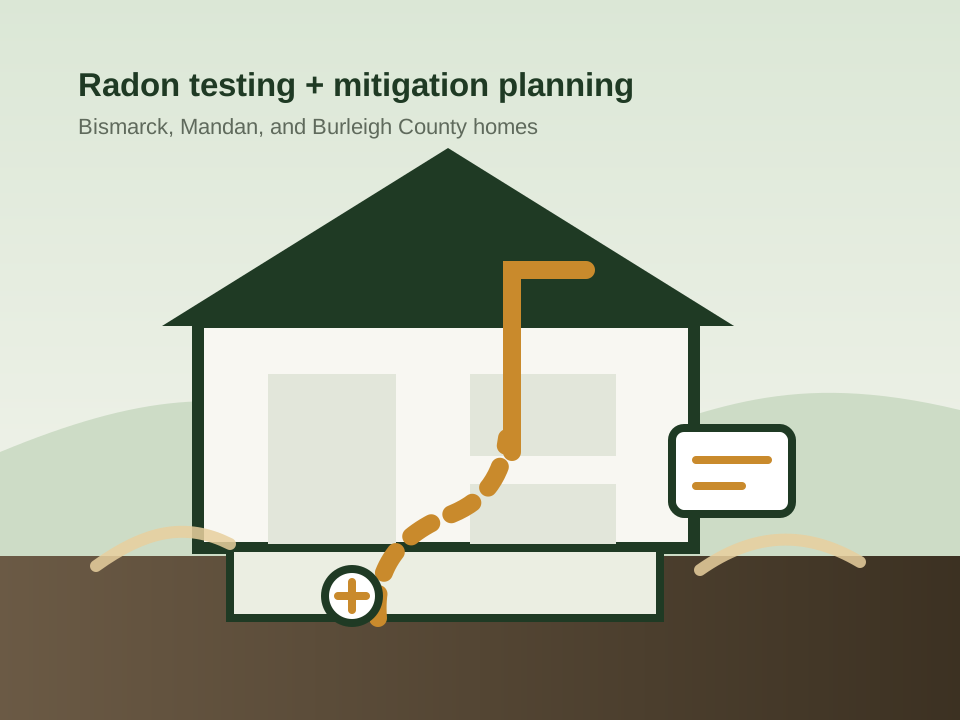
Because footings in this climate already have to be placed well below the frost line, many builders across the Bismarck-Mandan area have long treated a full basement as a standard, low-marginal-cost part of new-home construction rather than an upgrade. The result is a housing stock with a higher share of full or partial basements than many other parts of the country, along with finished lower levels used as bedrooms, family rooms, and home offices. That matters for radon because a basement floor sits in direct contact with the soil beneath it, and finished lower-level living space means people spend real time in the part of the home closest to the source. Homes with a basement are typically well suited to sub-slab depressurization, the most common mitigation method used in this region, while homes with a crawl space or a mix of foundation types may need a different approach.
Real Estate, New Construction, And Existing Homes
Radon comes up in a few recurring situations locally. Buyers and sellers frequently order a test during the inspection period of a real estate transaction, where results need to be available before a closing deadline. Builders and buyers of new homes increasingly ask about radon-resistant construction that is far easier and cheaper to include at the framing stage than to retrofit later. And existing homeowners who have never tested, or who bought a home years ago without a result on file, often start with a straightforward test to see where they stand. Each situation has a different timeline and a different starting point, which is why this site keeps those pages separate rather than combining everything into one general page.
North Dakota's Radon Program And EPA Guidance
The North Dakota Department of Environmental Quality maintains information on radon testing and mitigation for state residents, and directs homeowners toward current federal guidance and vetted professionals when it comes to choosing testing devices, checking contractor credentials, or deciding on mitigation. According to the EPA, radon exposure is the second-leading cause of lung cancer in the United States after smoking, and it has been linked to an estimated 21,000 lung cancer deaths nationwide each year. The EPA recommends fixing a home at 4 pCi/L or above and considering a fix between 2 and 4 pCi/L. Those figures come from federal guidance rather than from this site, so anyone weighing a test or a mitigation decision should check current numbers directly against EPA and North Dakota Department of Environmental Quality publications instead of leaning on a neighbor's result or a house's age as a stand-in.
Getting Started With A Request
A useful first request includes whatever test result you already have, the property's foundation type, the general area within Bismarck, Mandan, Lincoln, or the wider Burleigh County region, and any deadline tied to a closing or remodel. See the mitigation cost guide for what typically affects pricing once you are ready to move from planning to a quote.
Common Bismarck Radon Questions
- Is radon really a concern in Bismarck and Burleigh County?
- Yes. Burleigh County and Morton County are both classified in the EPA's Zone 1, its highest radon potential category, though the only way to know an individual home's level is to test it.
- What radon level requires action?
- The EPA recommends fixing a home at 4 pCi/L or above and considering a fix when a result falls between 2 and 4 pCi/L.
- Is testing more accurate in winter?
- Many radon professionals recommend closed-house winter testing because North Dakota homes are sealed up tightest during the heating season, which tends to produce a more representative result than a mild-weather test with windows open.
- Do newer homes in Bismarck-area subdivisions still need testing?
- Yes. Even homes built with radon-resistant features should be tested after move-in to confirm the passive system is working, since some homes need an added fan to become fully effective.
- Does a full basement always mean higher radon risk?
- Not automatically, but a basement floor sits closer to the soil than a home without one, and finished lower levels mean more time spent in that part of the house, which is part of why testing is worth doing regardless of a home's age or size.
- Where can I find official radon guidance for North Dakota?
- The North Dakota Department of Environmental Quality and the EPA both publish current radon testing and mitigation guidance, and are the most reliable sources for program-specific and technical questions.